What the Research Says
Reading pens are a form of assistive technology specifically designed to help students bypass weak word-decoding and vocabulary skills associated with reading disabilities such as dyslexia. Despite their widespread classroom adoption, the peer-reviewed evidence base remains limited.
Only two known studies had examined the effects of reading pens on the comprehension of school-aged students, and no known studies had been published on post-secondary students. A subsequent investigation of three post-secondary students with university-recognized reading disabilities used an alternating treatments design — comparing a reading pen decoding accommodation, a combined decoding and vocabulary accommodation, and a no-accommodation control condition on college-level reading passages.— Peer-reviewed assistive technology research, 2022
Key finding: reading pen use did <strong>not</strong> uniformly improve comprehension across all participants. However, the student with the poorest baseline reading skills benefitted the most — underscoring that reading pens are most effective when matched to students with severe decoding deficits as part of an individualized accommodation plan.
These findings have direct implications for IEP and 504 planning teams: reading pens should be evaluated alongside other supports such as human readers, screen readers, and text-to-speech software rather than adopted as a universal intervention. For a technology primer, see <a href="/guides/how-pen-scanners-work/">how pen scanners work</a>, or compare current devices in the <a href="/guides/pen-scanner-comparison/">full model comparison</a>.
What Is a Reading Pen?
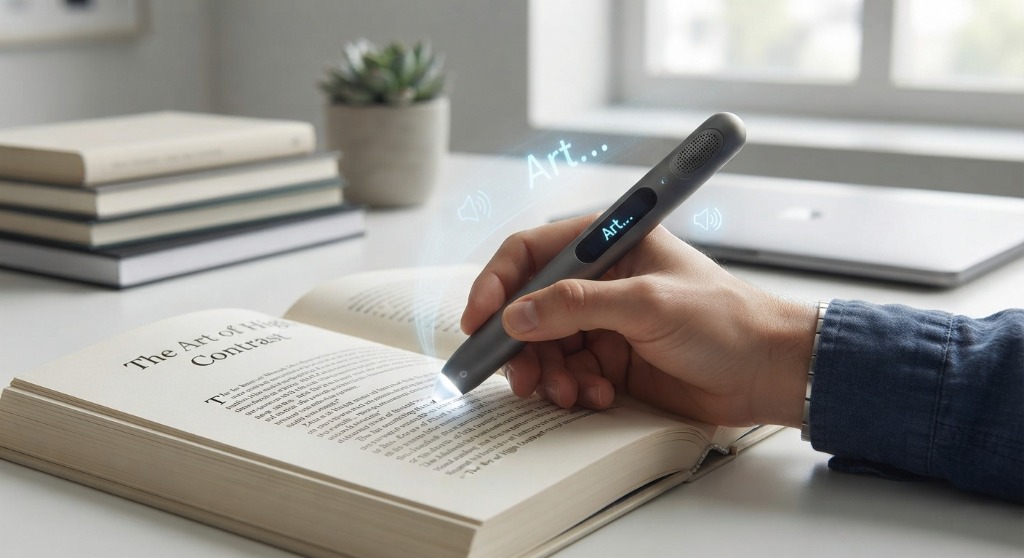
A reading pen is a portable handheld assistive device that uses optical character recognition (OCR) combined with text-to-speech (TTS) software to scan printed text and read it aloud — without requiring a phone, tablet, or internet connection.
- Core Function: Scans physical text line-by-line or word-by-word, converting letters into audio playback through a built-in speaker or 3.5 mm headphone jack.
- Operation: Held at approximately 75 degrees against the page and drawn smoothly across the text from left to right.
- Primary Users: Students with dyslexia or other reading disabilities, English language learners, and professionals working with foreign-language documents.
- Connectivity: Most models operate entirely offline — no Wi-Fi required — ensuring user privacy and exam room eligibility.
- Built-in Extras: Standard units include dictionaries, translation features (40–112 languages depending on model), and voice memo recording.
Exam-specific models remove dictionaries, storage, and translation entirely to satisfy formal testing authority requirements. See <a href="/guides/pen-scanner-comparison/">the pen scanner comparison</a> to find which model fits which use case.
Functional Classification by Use Case
Institutional assistive technology catalogues classify handheld reading pens under optical text-to-speech assistive appliances (ISO 9999 code 22.30.21). The table below maps each tier to its hardware profile and primary deployment environment.
| Classification Tier | Hardware Profile | Target Environment |
|---|---|---|
| Standalone Phonics Reader | Single-purpose, embedded LCD, offline TTS, no wireless — Scanmarker PAL ($179) | Elementary education, resource rooms, distraction-free home study |
| Standalone Comprehensive | Touchscreen, offline dictionary, exam lock, 30+ offline translation languages — Scanmarker Max ($299) | High school, standardized test centres, university disability offices |
| Tethered BLE Scanner | Lightweight stylus form factor, Bluetooth Low Energy, host app dependent — Scanmarker Air ($149) | Higher education research, mobile professional document workflows |
| Tethered USB Scanner | Wired USB interface, zero latency, direct keyboard emulation — Scanmarker USB ($99) | Data processing, corporate document management, lab environments |
Mechanical Profile & Ergonomics
The physical form factor of a reading pen directly determines long-term usability across student age groups and disability profiles. The following parameters represent the standard engineering envelope for modern handheld devices.
| Parameter | Specification | Operational Impact |
|---|---|---|
| Dimensions | Length 135–146 mm · Width 31–33 mm · Height 14–19 mm | Mirrors a standard marker — grasp familiarity reduces learning curve |
| Weight | 50 g to 72 g | Minimizes muscular fatigue during extended reading blocks |
| Enclosure Material | High-impact Polycarbonate / ABS (PC-ABS) blend | Withstands daily drops, torsional stress, and localized impacts |
| Scanning Tip Actuator | Micro-switch spring · Operating Force: 1.2 N – 1.8 N | Triggers optical sensor and LEDs instantly on page contact |
| Orientation Inversion | Software-configurable 180° symmetrical housing | Full left-handed and right-handed native use without physical modification |
Optical & Scanning Specifications
OCR accuracy is a direct function of sensor resolution, illumination quality, and the on-device character recognition engine. The optical pipeline follows a consistent architecture: LED illumination → CMOS capture → edge normalization → AI character recognition → TTS audio output.
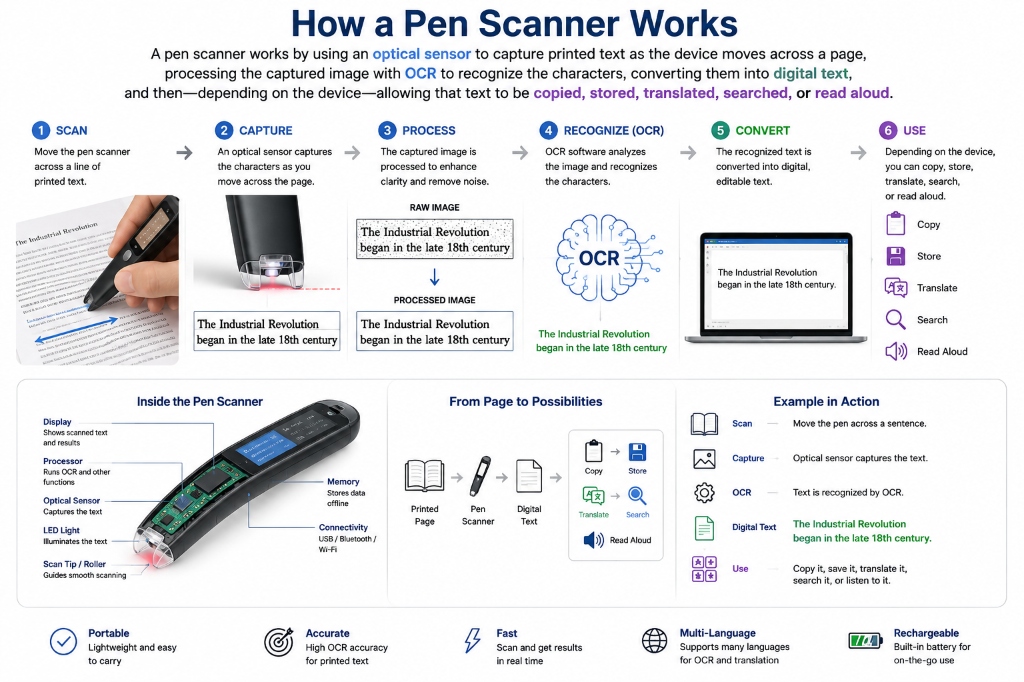
- Image Sensor: Linear high-speed monochrome/RGB CMOS sensor capturing at 100+ frames per second.
- Optical Resolution: 600 DPI to 1200 DPI along the scanning axis.
- Illumination: Dual 620–630 nm visible-red or ultra-white LEDs providing consistent lux levels — suppresses glare on glossy or laminated sheets.
- Tracking Speed: Fluid character recognition from 3 cm/s up to 15 cm/s.
- Font Size Range: Core OCR engine handles 6.5 pt to 24 pt printed text.
- Typographic Support: Optimized for Serif and Sans-Serif print with skew-correction up to ±10°.
Compute, Display & Power Architecture
Processing power determines how quickly scanned text converts to speech — critical for students who lose comprehension when audio lags behind scanning pace.
| Component | Specification | Notes |
|---|---|---|
| CPU | 600 MHz single-core RISC (basic) to 1.2 GHz dual-core (advanced) | Higher clock speeds reduce TTS latency on complex or small fonts |
| Display | 2.3-inch color touchscreen or 256×64 OLED matrix | High-contrast profiles for users with visual tracking variance |
| Battery | 600 mAh to 1200 mAh lithium-polymer cell | ≥ 8 hours continuous scan and TTS per charge |
| Recharge Interface | USB Type-C or Micro-USB with standard power management | No proprietary cables required |
| Storage (Standard) | Internal flash for word history and voice memos | Disabled entirely in exam-lock firmware builds |
Acoustic Output & Text-to-Speech Processing
Audio quality and naturalness of TTS voices directly affect comprehension — particularly for students with phonological processing difficulties. Modern reading pens use embedded neural synthesis rather than older concatenative TTS engines.
| Subsystem | Specification |
|---|---|
| DAC Pathway | Embedded 24-bit stereo audio processor mapping phonemes to standard audio output |
| Internal Speaker | Monaural 0.5 W – 1.0 W · adjustable 45 dB SPL to 85 dB SPL |
| Audio Boost Mode | Firmware-controlled +3 to +6 dB compression on speech frequencies for high-noise environments |
| Wired Output | 3.5 mm auxiliary line-out for classroom headphones |
| Wireless Output | Bluetooth 5.1 A2DP on supported models (disabled in exam-lock mode) |
| TTS Languages | Natural-voice synthesizers: English (multiple dialects), Spanish, French, German, and additional languages by model |
Regulatory Compliance & Exam Lock
Reading pen devices carry two distinct compliance profiles: standard consumer electronics certifications (required for all models) and specialized examination accommodation certifications (required for exam-compliant variants only).
Hardware & Electromagnetic Standards — All Models
- FCC Part 15 Class B: Certifies radio-frequency emissions do not cause harmful interference in residential and educational spaces.
- CE / UKCA Marking: Structural, electrical, and electronic protection verification across the EEA and UK.
- RoHS 3 Compliance: Complete restriction of hazardous substances — lead, cadmium, polybrominated biphenyls — in device assembly.
Exam Lock Firmware — Certified Testing Models
To comply with the <a href="https://www.jcq.org.uk/" rel="noopener noreferrer">UK Joint Council for Qualifications (JCQ)</a>, Australian NAPLAN/ATAR frameworks, and major US testing guidelines, exam-certified models must implement all three hardware-enforced constraints:
- Zero Storage Isolation: Volatile-only RAM operation — all text strings purged on power-off, leaving zero traces of exam content.
- Air-Gap Network Compliance: Wi-Fi, cellular, and external storage interfaces physically disabled — device operates as a closed local system.
- Semantic Constraint: TTS output only — dictionaries, translation engines, and thesaurus databases removed from firmware to prevent testing advantages.