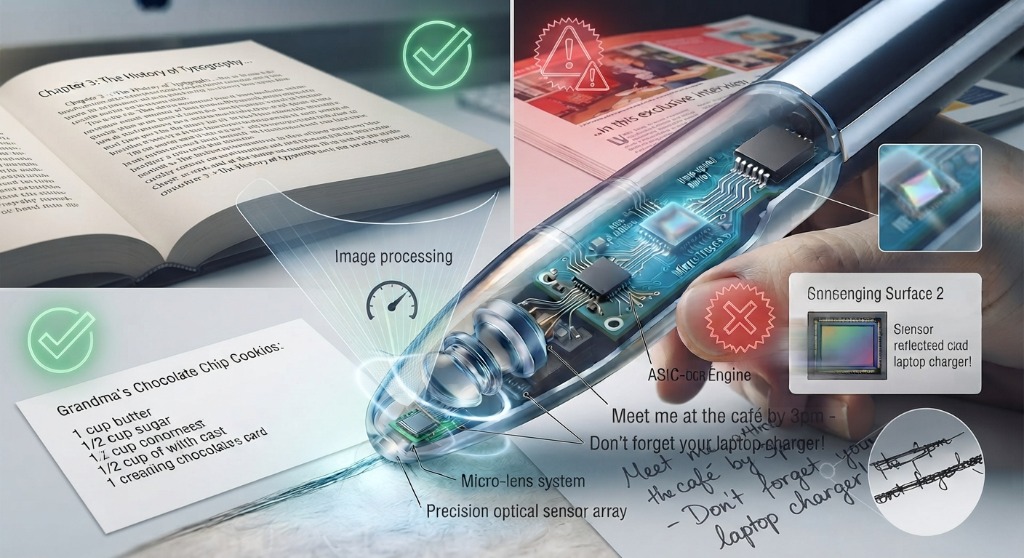
Inside the PenScanner.org Testing Lab: Empirical Data Over Vendor Marketing
We do not accept paid product placements, we do not allow manufacturers to review or alter our editorial findings, and we apply one unyielding evaluation rubric across every device in our lab. This document outlines our standardized testing deck, our acoustic measurement protocols, our scoring formula, and our commercial disclosures.
The 8 Pillars of Our Testing Methodology
Every pen scanner that enters our facility is subjected to rigorous evaluation across eight distinct performance pillars:
- 1. Optical Sensor Dynamics & Motion Tracking: We measure camera frame rates (60 vs 120 fps), resolution (300 to 600 DPI equivalent), and pitch/roll angle tolerances. We test how far the pen can tilt from vertical (60° to 90°) before tracking breaks.
- 2. OCR Accuracy Across 5 Standardized Substrates: Using a mechanical linear gantry slider moving at controlled velocities (10 cm/s, 15 cm/s, 25 cm/s), we test character recognition accuracy across 80gsm copy paper, 45gsm newsprint, 120gsm glossy textbook stock, tight book spine gutters, and micro-print footnotes.
- 3. Acoustic Intelligibility & Speech Latency: We measure sound pressure level (SPL in decibels) at 30cm, frequency response curve (evaluating vocal formant clarity for sibilants like "s" and "sh"), and audio playback latency from scan completion to first spoken syllable.
- 4. Interface Ergonomics & Display Readability: We evaluate screen touch latency, resolution, color accuracy, and legibility under direct 500-lux ambient classroom lighting.
- 5. Tactile Weight & Hand Fatigue: Devices are weighed on precision digital scales. We assess grip center-of-gravity and run continuous 45-minute fatigue trials with both adult and pediatric testers.
- 6. Software Ecosystem & Cross-Platform Drivers: We benchmark Bluetooth Low Energy (BLE) pairing stability, reconnection speed after sleep, virtual keystroke (HID) injection fidelity, and companion software stability across Windows 11, macOS Sequoia, ChromeOS, iOS, and Android.
- 7. Battery Endurance & Thermal Dissipation: We conduct continuous automated scanning discharge cycles until low-battery shutdown occurs, measure standby sleep drain over 7 days, and record USB-C recharge curves and surface operating temperatures.
- 8. Physical Durability & Impact Resistance: Devices undergo three standard 1.2-meter drops onto carpeted school flooring and 500 abrasive slide cycles to evaluate optical lens scratch resistance.
The Standardized Testing Deck: Standardized Fonts, Sizes, and Layouts
Accuracy is calculated as: (Total Printed Characters - Recognition Errors) / Total Printed Characters * 100%. Any substituted letter, dropped punctuation mark, or merged character is classified as an error.
| Test Deck Category | Typography & Print Parameters | Pass Benchmark | Why It Matters |
|---|---|---|---|
| Standard Serif Deck | 12pt Times New Roman, 1.5 line spacing, 80gsm matte | > 99.5% accuracy | Baseline book and literature reading standard |
| Standard Sans-Serif Deck | 11pt Arial & Calibri, 1.15 line spacing, 80gsm matte | > 99.5% accuracy | Standard school worksheets and office documents |
| Micro-Typography Deck | 6pt, 7pt, 8pt Academic Footnotes & Legal Citations | > 98.0% accuracy | Ensures university researchers can capture small references |
| Dyslexia-Tuned Deck | 12pt OpenDyslexic & Comic Sans typefaces | > 99.0% accuracy | Confirms compatibility with specialized assistive materials |
| Substrate Stress Deck | 45gsm low-contrast newsprint & 120gsm high-gloss textbook | > 98.0% accuracy | Tests sensor illumination and anti-glare reflection mitigation |
| Gutter & Spine Curve Deck | 75° tilt angle inside bound 600-page hardcover gutter | > 97.0% accuracy | Ensures students can read inner margins without tearing pages |
Acoustic Analysis: Measuring Speech Clarity and Auditory Fatigue
For individuals with dyslexia or auditory processing disorders, speech intelligibility is just as critical as OCR accuracy. A speech synthesizer that mumbles or clips consonant sounds increases cognitive fatigue.
In our acoustic testing suite:
- We place calibrated omnidirectional microphones 30cm from the pen speaker in a sound-dampened chamber.
- We record playback of standard phonetic diagnostic passages (such as the Harvard Sentences).
- We measure total harmonic distortion (THD) and vocal clarity between 1 kHz and 4 kHz—the frequency range essential for understanding human consonants.
- We test audio output levels through standard 3.5mm wired headphones and Bluetooth wireless earbuds to ensure zero distortion and safe listening volume limits.
Our Scoring Rubric & Weighting Formula
Our final weighted score (out of 10.0) provides an objective benchmark for overall hardware excellence, while our role-specific recommendations identify the ideal device for individual workflows.
| Evaluation Criterion | Weighting % | Primary Metric Measured |
|---|---|---|
| OCR Accuracy & Speed | 25% | Character accuracy on standard & stress substrates at 15 cm/sec |
| Assistive Usability & Ergonomics | 20% | Grip comfort, touchscreen responsiveness, left/right-hand agility |
| Audio & TTS Intelligibility | 15% | Speech naturalism, frequency response, headphone connectivity |
| Battery Endurance & Power | 15% | Continuous runtime on single charge, USB-C recharge rate |
| Software & Connectivity | 15% | BLE stability, HID keystroke speed, cross-platform compatibility |
| Price-to-Value Ratio | 10% | Hardware performance relative to retail MSRP and competitor pricing |
Editorial Independence, Conflict of Interest Policy, and Affiliate Disclosure
Editorial Disclosure & Independence: PenScanner.org is an independently operated consumer testing guide. We do not accept paid reviews, sponsored rankings, or pre-approval conditions from hardware manufacturers. Some links on this site are affiliate links to manufacturer direct stores (such as Scanmarker) and online retailers (such as Amazon, Associate ID: thebest07bf-20). If a reader clicks an affiliate link and makes a purchase, we may receive a referral commission at no additional cost to you. This commercial relationship does not influence our laboratory benchmarks, scoring formulas, or critical assessments. If a product performs poorly in our lab, our reviews state so clearly. Learn more about our team and testing mission.